

trial by fire
jokić, giannis and luka return to europe’s cruelest stage with everything left to prove.
note: during august, bang! will publish friday editions only.
the eurobasket is a trial by fire. it is where talent stops being potential and becomes legacy. where careers are carved in stone, where hierarchies are not debated on podcasts but defined possession by possession. pau gasol in lille, dirk nowitzki in belgrade, nikos galis in athens, goran dragić in istanbul — the pantheon is short because the exam is merciless. a full month of suffocating tactics, overloaded rosters, arenas packed with hostility. eurobasket punishes hesitation and rewards only sustained brilliance.
in 2025, three giants walk back onto this stage with unfinished business tattooed across their résumés: nikola jokić, giannis antetokounmpo, luka dončić. each one arrives scarred, carrying history’s weight, forced to prove that individual greatness can survive the suffocating ecosystem of national-team basketball. orbiting them is a second line of rising stars — players desperate to turn promise into permanence. because here, being good is meaningless. at eurobasket you must be immortal.
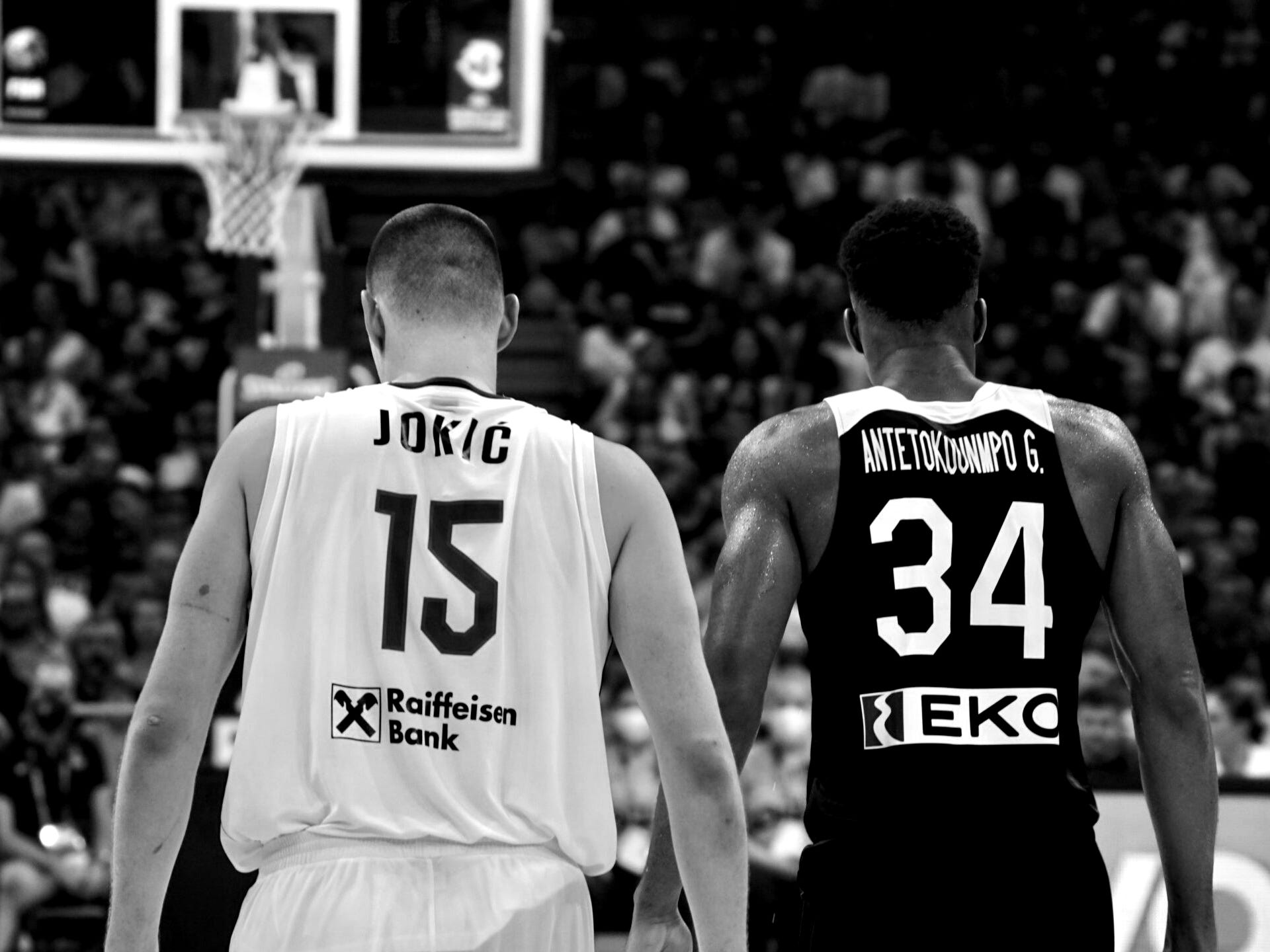
nikola jokić lands in riga not as a player but as an inevitability. three mvps, one championship, statistical mutations that broke entire models. in denver there is nothing left to prove; with serbia, almost everything remains. a nation that counts its basketball heritage in dynasties and medals hasn’t touched eurobasket gold since independence. silvers, bronzes, heartbreaking finals — but no coronation.
and so the paradox: the best player alive carrying a résumé that feels half-finished. his relationship with the eagle jersey has always been complicated — part nba schedule, part body management, part balkanic melodrama. he skipped 2022, returned for the 2023 world cup only to see germany strangle his rhythm, watched the 2024 olympics slip away in the final possessions. pesić preaches “realism,” bogdanović whispers “gold,” and jokić, the most reluctant superstar of his generation, suddenly has no more escape routes.
the burden is total. every camera in the arena will expect triple-doubles dressed as poetry, every fan in belgrade will demand catharsis in the form of gold. and the cruel irony is that jokić doesn’t play for legacy, doesn’t posture for statues — but the stage demands it anyway. this summer is not about his brilliance, already beyond doubt. it is about whether brilliance can bend history into placing serbia back on the european throne.
giannis antetokounmpo has conquered everything the nba could hand him. two mvps, one finals mvp, a defensive player of the year, the 50-point masterpiece that delivered milwaukee its first ring in half a century. he is a global brand, a walking documentary, a superhero rebranded as greek freak. and yet his international résumé remains embarrassingly bare.
greece hasn’t touched a eurobasket podium since 2009. the anthem echoes across europe but never ends draped in gold on giannis’s shoulders. 2022 collapsed with a whimper, 2023 and 2024 repeated the same pattern: promises dissolving under pressure. at 30, with his physical prime intact and his legend secure in america, he still carries the desperate need to deliver something eternal at home.
this summer almost began with absurdity — not an injury but paperwork. giannis was sidelined in friendlies not because his body betrayed him but because an insurance form wasn’t signed. bureaucracy delayed greatness. now cleared, now unleashed, he arrives fresher, angrier, the calendar aligned for revenge.
for all his dominance, giannis cannot be considered complete without a medal in blue and white. this isn’t about dunks or stat lines, it’s about filling the screaming void in his career. he either ends greece’s 16-year drought or adds another cruel irony to a career otherwise scripted like a fairy tale.
luka dončić already tasted eurobasket immortality. in 2017 he was a teenager, a sidekick orbiting goran dragić’s farewell, and together they dragged slovenia to an improbable, delirious title. eight years later the roles have flipped: dragić is gone, the roster is thinner, and luka is no longer prodigy but prophet. at 26 he carries not only a nation but the expectation of reproducing the impossible — this time without help.
his summer has been a metamorphosis. traded from dallas to the lakers in february, luka responded with a kind of monastic obsession: fasting diets, footwork drills at dawn, weight work designed to carve off the bulk that slowed him last season. he arrives leaner, quicker, visibly more explosive — rewriting his own biography mid-chapter. every leaked training-camp photo has been part transformation, part manifesto: this is a different luka.
but the urgency is deafening. slovenia lacks the depth of spain, the tradition of serbia, the raw force of greece. they only have dončić, and that might have to be enough. he plays now with the conviction that the stage is his habitat, that the federation’s mediocrity can be papered over by one transcendent talent.
for luka this isn’t just about proving slovenia can still win. it’s about proving that he himself — amid nba chaos and franchise betrayals — still dictates outcomes on the biggest stages. eurobasket once crowned him early; now it tests whether he can crown himself again, alone, against a continent of giants.

germany no longer hides behind dirk nowitzki’s shadow; the 2023 world cup burned that excuse to ash. but a world title creates a new tyranny: repeat or be dismissed as a fluke. dennis schröder remains the noisy captain, yet the future is taller, calmer, and wears orlando magic colors. franz wagner is not wired for theatrics — his face rarely changes, his game stripped of drama — but the responsibility is colossal. to validate germany’s rise, he must be the axis, the two-way presence that proves the 2023 miracle was only the beginning. in a tournament addicted to narrative, he has to become one.
every turkish golden generation arrives with trumpets and leaves in silence. the last medals are relics, the country perpetually oscillating between talent and collapse. alperen şengün is the latest messiah offered to the crowd, a center whose houston tapes already look like puzzle pieces stolen from jokić’s library. dazzling footwork, odd angles, passes that whisper rebellion. but eurobasket is where illusions are slaughtered. here şengün must stop being potential and start being inevitability. if turkey dares dream of relevance, it will be through him turning chaos into dominance.
latvia has always been the clever outsider — tactical, technical, doomed to run out of weapons against the empires. kristaps porziņģis was supposed to rewrite that ceiling years ago, but the nba turned him into a ghost: flashes of unicorn brilliance drowned in endless injury reports. now, finally healthy and finally home, he walks into riga with the chance to bend history. for porziņģis this eurobasket is not about immortality — too many years already lost. it is about redemption, about proving that latvia’s golden age is not a one-act play. in front of his own people, he either delivers relevance or confirms the curse.
spain has lived off inheritance for two decades, a dynasty stretching from pau and marc gasol to ricky rubio and juan carlos navarro. now the trust fund is empty, and santi aldama walks into court to see if he can pay the bills. his nba seasons in memphis have shown versatility, flashes of creation, but never the suffocating weight of leadership. the red jersey does not forgive. aldama is not asked to be pau — nobody can — but he is asked to prove that the lineage has not been broken.
the eurobasket always reserves a corner for men who refuse to fade quietly. jonas valančiūnas is that corner. 33 years old, still bruising opponents, still carrying lithuania like it’s 2013. but the game has shifted away from him, toward speed and space, and time no longer negotiates. his résumé is littered with podiums and near-misses, yet the one line missing is the simplest: champion. without it, he risks being remembered as the eternal lieutenant, never the general. this might be his last chance to change that, to stand in the paint one final time and remind europe that relentlessness, too, can be a legacy.
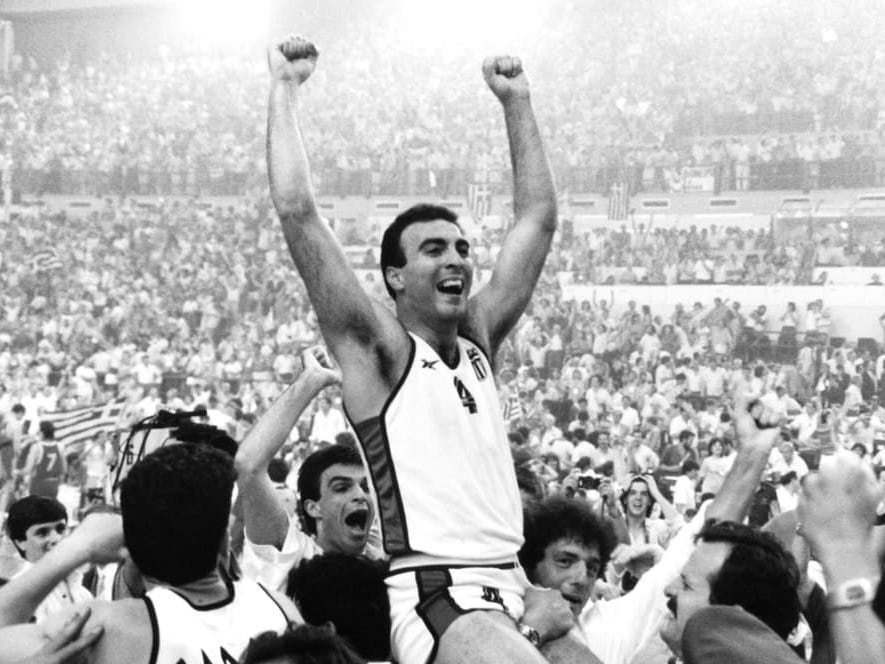
the eurobasket does not forgive, but it never forgets. it is where gasol carved france into silence, where galis turned athens into a temple, where dragić staged his farewell as if possessed. every generation thinks the pantheon is already full, and every generation discovers there’s still room for one more.
in 2025 the question is not who plays well — plenty will. the question is who survives the weight of expectation, bureaucracy, injury, myth, and turns two weeks of suffocating basketball into eternity. for jokić it is about inevitability, for giannis about erasing absence, for dončić about duplicating a miracle without a net. for wagner, şengün, porziņģis, aldama, it is about snatching permanence from the shadows. for valančiūnas and the veterans, it is about how to roar one last time before the lights go out.
the eurobasket is not a tournament. it is a judgment. in limassol, in tampere, in riga, in katowice, across arenas thick with memory and hostility, the next immortal waits to be revealed.