

the things the knicks refused
brunson took $113 million less. towns stopped shooting. bridges stayed in the lineup. history happened.
april 23. game 3 of the first round against atlanta. mikal bridges had scored zero points, committed four turnovers, and been a net negative in all three games. the knicks trailed the series 2-1 and looked like the team everyone recognized: the knicks of a thousand postseason complications, finding a way to burden the obvious. bridges cost five first-round picks. he was invisible. he was a turnover machine. he was the reason, if you needed one, to make a change.
mike brown did not make one.
nobody would have blamed him. the calculus was simple: bridges is struggling, insert landry shamet, adjust the pieces, demonstrate command. that is how coaches respond to adversity in a seven-game series. you show the players you see the problem. you move.
brown demonstrated something harder: certainty in the face of evidence.
he kept bridges in the starting five, kept the lineup intact, kept the structure that had produced a plus-3.7 net rating across a full regular season and a minus-6.2 net rating in last year’s postseason. numbers that do not suggest a dynasty in waiting. he kept it because he had watched enough film to know that bridges was not the problem. the problem was noise. the solution was the same five, playing harder.
game 4 in atlanta. bridges did not erupt: nine points. the knicks won by 29. game 5: 11 points. the knicks won by 20. somewhere between those two games, the noise stopped being louder than the film.
in the eight wins that followed, bridges averaged 17.9 points on 45.8% from three and 74.5% on twos. he throttled nickeil alexander-walker, tyrese maxey, and james harden one possession at a time. the player everyone wanted out of the lineup became the player nobody could guard.
eleven straight wins. the largest point differential across any 11-game span in nba history, regular season or playoffs. the knicks are going to the nba finals.
the non-move was the move.
but brown made a second one, and this one has a timestamp.
game 1 of the eastern conference finals. madison square garden. the cavaliers led by 22 points with seven minutes left in the fourth quarter. brunson had been picked apart by cleveland’s pick-and-roll coverage in the third quarter, the cavs generating 140 points per 100 possessions in that period. josh hart was in the lineup. hart has been a cornerstone of this run for three years: the connector, the engine, the guy who fights for everything in the spaces where nobody is watching. he was also shooting near the floor of his range from three in these playoffs, and the spacing brunson needed was not materializing.
brown put shamet on the court.
the lineup with shamet instead of hart went plus-36 in 12 minutes.
thirty-six points. twelve minutes. those numbers do not require explanation; they require context. shamet had spent most of the regular season injured. he is a catch-and-shoot specialist who does one thing at an elite level and does everything else at barely sufficient. what he does to a defense when brunson is operating alongside him is close to geometric. he opens lanes that did not exist, forces decisions defenses cannot process fast enough, and turns good shots into open ones by standing in the right place long enough.
in the ecf, shamet shot 11-for-12 from three. four-for-four in game 4. lineups with shamet and towns together: plus-35 net rating in the playoffs. lineups with brunson and shamet: plus-28.6. this was not a hot streak arriving at the right moment. the regular-season data was identical: the knicks were 2.3 points per 100 better with shamet on the court and 2.5 better with hart off it. brown read the data all season. he waited for the right four minutes of a game to act on it. when he did, the cavs had already committed their defensive structure for the night.
not a reaction. a read.
the third refusal belongs to karl-anthony towns, and it is the strangest one, because it required him to undo something he had spent a decade building.
towns entered the nba in 2015 as the first overall pick, immediately establishing himself as one of the most gifted offensive players at his position in league history: a seven-footer who could shoot deep threes, finish at the rim, attack off the dribble, and rebound at an elite rate. the criticism always circled the same axis. defense, foul trouble, absence from winning. what nobody diagnosed, or at least nobody treated, was the offensive identity problem underneath.
towns had been built to score. every system he played in asked him to score. he scored, the team lost, the loop continued for nine years.
in new york, with brunson as the fulcrum and brown’s offense as the container, something shifted. towns began operating as a high-post hub. he passes over the top of defenses, reads the geometry of the floor before the help rotation arrives, and releases the ball into the exact lane that opens two seconds later. this was not, historically, what karl-anthony towns did. this is what karl-anthony towns does now.
in these playoffs, towns is averaging 6.1 assists per game, more than double his regular-season average. his shot attempts dropped from 15.8 per game in last year’s postseason to 9.8 this year. fewer shots, more offense, and the knicks are outscoring opponents by 19.4 points per game.
sixty-two percent of brunson’s three-point attempts in these playoffs have been assisted. in the regular season, that number was 55.9. the pipeline is direct: towns reads the defense from the high post, brunson comes off a screen into a clean look, the shot goes in. it sounds simple because it is, and simple things are almost impossible to execute with this consistency against playoff defenses at this level.
towns gave up the thing he was best at: individual creation, volume scoring, being the answer. in order to become the question defenses could not answer. he finished the ecf with a series-high plus-79. he took 11 shots in game 4 and ended with 19 points and 14 rebounds.
he got there through his third consecutive conference finals appearance. the first two, with minnesota, ended without towns advancing past that round. this one ends with a shot at the larry o’brien, and the transformation that made it possible was refusing his own instincts.
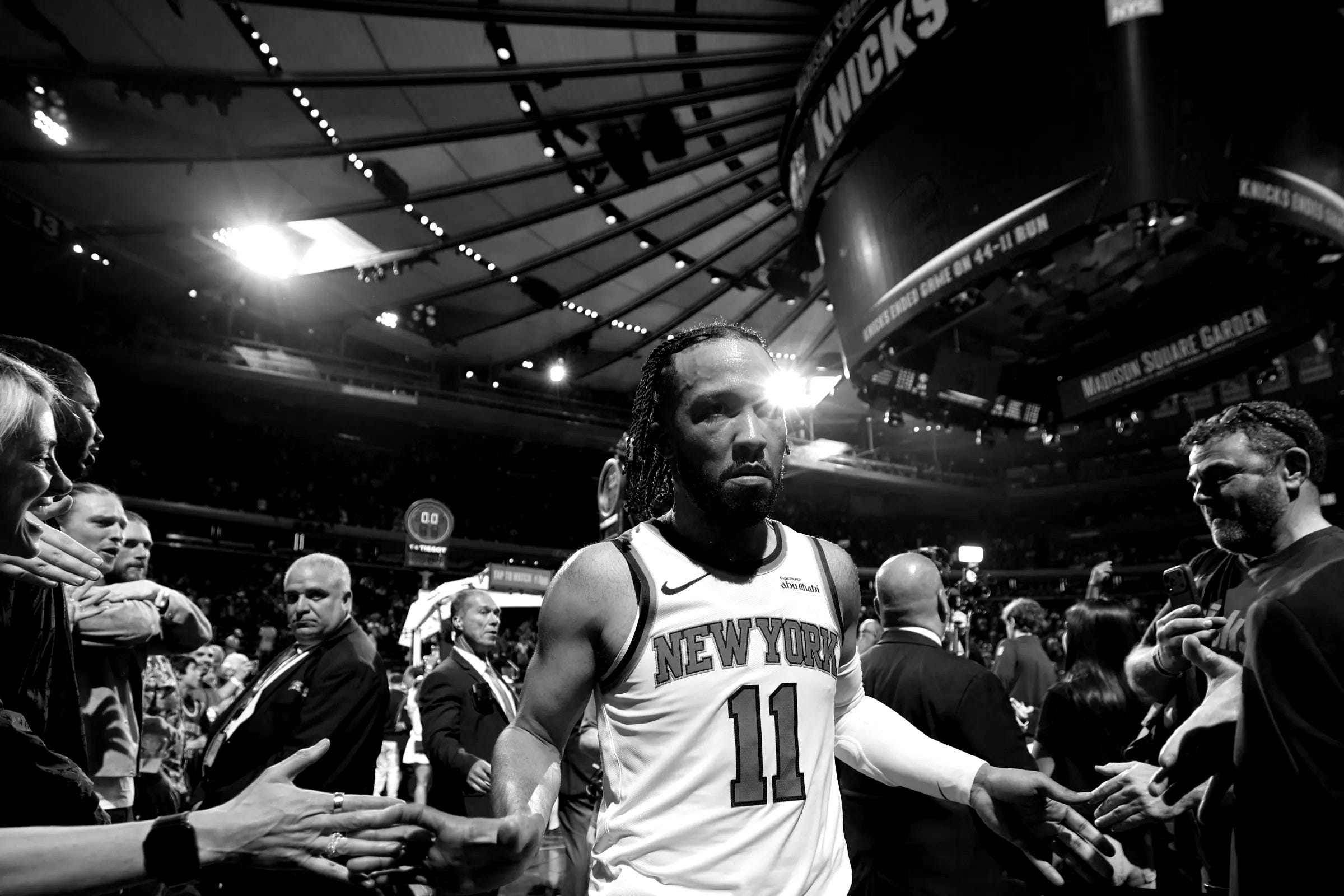
then there is the money.
in the summer of 2024, brunson signed a four-year extension worth $156.5 million. the number sounds enormous until you check the comparable. the max he could have commanded, waiting one more year, testing free agency, leveraging three all-nba selections and an ascending market, was approximately $269 million. he left $113 million on the table, deliberately, to create the financial conditions that made the current knicks roster possible.
og anunoby’s retention. mikal bridges’ extension. karl-anthony towns’ supermax. all of it fit inside the cap structure because brunson chose not to take what was rightfully his.
players do not do this. the history of nba free agency is a history of maximizing leverage at the moment the market peaks, and doing so rationally, because careers are short and the money is real and nobody gives it back. brunson gave it back. or rather, he traded it for something he valued more: a real shot, with the right people, at the right time.
the knicks are built around a player who decided he was worth less than the league would have paid him, because he had done the math on what winning required and found the number on his own contract to be a variable he could control.
behind all of it, there is a longer timeline, and at the end of it, a man who has been here before and did not get what he came for.
rick brunson played for the new york knicks in 1999. he appeared in nine playoff games, contributed minimally, and watched his team lose the nba finals to san antonio in five games. he is now an assistant coach on the same bench where his son will play in his first nba finals.
the elder brunson was not a foundational piece in 1999. he was depth: a guard who filled minutes and wore the colors without being the engine. his son arrived at the knicks in 2022 as a free agent, officially evaluated on merit, officially acquired through a front office process that had started two years earlier with a simple refusal. brock aller, the salary cap specialist leon rose brought in from cleveland in 2020, had been protecting a stack of first-round picks with the kind of attention that borders on ritual. when the dallas mavericks called in the winter of 2022, seeking those picks as compensation for brunson ahead of free agency, aller said no. rose said no. the knicks absorbed the risk of losing their target to the open market rather than trade assets to guarantee him four months early.
dallas let brunson walk. new york signed him for $104 million, a contract the rest of the league received with skepticism. too small. the product of nepotism. overpaid for what he was. he averaged 24 points in year one. made the all-star game. made all-nba three consecutive times. finished fifth in mvp voting. signed the extension at $113 million below market. and on monday night in cleveland, standing beside former villanova teammates josh hart and mikal bridges, he accepted the ecf mvp award from the hands of walt frazier and patrick ewing.
the brunsons join the bryants, joe and kobe, among father-son duos to make an nba finals appearance. the symmetry has a simple explanation. the front office accumulated a specific kind of patience for four years, deployed it in one direction, and never reached for something larger when something larger was in the room.
the knicks’ closeout wins this postseason: 51 points over atlanta, 30 over philadelphia, 37 over cleveland. three road games. three arenas that were supposed to be hostile and became something else entirely.
the running margin across all 11 games is plus-262. the largest differential in any 11-game span in nba history, regular season included. the previous record belonged to the 2017 golden state warriors, who posted plus-196 across their first 12 games that postseason. the warriors had stephen curry and kevin durant. the knicks have five players who decided, collectively, to refuse the version of themselves that was easier.
“i don’t think a switch flipped. i think that was the start of the habits we were building,” hart said. habits. not moments. not sequences. habits, which means practices repeated until they stop feeling like choices and start feeling like the only possible thing.
towns refusing his shot volume. brunson refusing his market value. aller refusing to open the pizza box. brown refusing to change the lineup. bridges refusing to interpret three bad games as a signal about who he was.
the nba finals start june 3, against whoever comes out of san antonio and oklahoma city. the knicks will be underdogs.
the habits do not start in april. they never do.