

stress test
game 3 put four reputations in the same machine and read each one differently: the arena, the body, the prodigy, the coach.
17.3 feet. 15.2 feet. 10.6 feet. that is the average distance of victor wembanyama’s shots across three finals games, per geniusiq, and the curve reads like a fever breaking. here is another set. 13 turnovers for 21 san antonio points, against 8 turnovers for 7 new york points. another. 24 free throws to 8 in the second half, 14 to 3 in the third quarter alone. one more, from outside the building entirely. $11,000 for a seat in the upper balcony, $22,000 of credit card debt for one couple from the jersey shore, 21 people in custody near bryant park by morning.
the numbers come from four different instruments. tracking cameras, box scores, whistles, ticket markets. they all measured the same night, and they all returned the same finding. game 3 was a stress test. everyone walked into madison square garden carrying a reputation, and the machine read each one without sentiment.
start with the building, because the building went first. the garden had waited 27 years for a finals game and prepared for it like a body fighting off a transplant. a sitting president in a bulletproof box, the first ever at a finals. metal detectors stretching down the block. a watch party displaced to bryant park, where the night ended in fights, thrown bottles and five injured officers.
the assumption all spring was that this noise would function as a thirteenth win, the way it had carried new york through 46 days without a loss, the second-longest streak in playoff history. but a home crowd is a filter. it takes whatever a team brings and concentrates it. the knicks brought hands that betrayed them, two turnovers on their first two possessions of the game and two more on their first two possessions of the half. the garden concentrated that too.
san antonio brought the opposite reading. “at home it really feels like playing six against five. here it feels like five against six,” wembanyama said. he was smiling when he said it. the spurs scored 35 points on 22 third-quarter possessions, their best offensive quarter of the series, in the loudest room basketball can currently produce. the crowd arrived as a weapon and spent the third quarter working as a stethoscope. it just listened.
de’aaron fox took the test with a compromised sample. the ankle that cost him the first two games of the western conference finals never fully healed, and the readings showed it. 36% shooting on his return in that series. 3 of 13 in the finals opener. 3 of 13 again on monday, all five of his threes missing, plus a stumble and a live-ball turnover with a chance to extend the lead in the final minutes.
then, with 12.2 seconds left and a three-point lead wobbling, the spurs gave him the ball anyway. he waved off wembanyama, shook anunoby loose off the dribble, and dropped a stepback from the free-throw line. two minutes earlier he had snuck behind karl-anthony towns for a block that preserved the lead.
“it feels good to hit a big shot down the stretch,” fox said. the flatness of the sentence is the point. fox won the league’s first clutch player of the year award in 2022-23, and that history worked on monday as a kind of credit the box score could not see. san antonio trusted the resume over the sample. forty-six minutes of evidence said take the ball from him. one prior diagnosis said leave it. the body failed every reading except the last one, the only one anybody remembers.
wembanyama spent the morning of the biggest game of his life on a bench in gramercy park, drawing. no film. no walkthrough. a 22-year-old letting his brain cool before the loudest test available, which tells you how he processes pressure, which is to say, as information.
that is what the shot-distance curve actually documents. 17.3 feet in game 1, when the knicks’ tags pushed him toward the perimeter and he accepted the exile. 10.6 feet in game 3, when he refused it. he set 35 ball screens, the third-most of his 19 playoff games. he scored off four lobs after converting one in the first two games combined. 22 of his 32 points came at the rim or the line. his three blocks pushed his postseason total to 70, past dikembe mutombo’s record for a playoff debut since the stat was first tracked in 1974. at 22 years and 155 days, only magic johnson has posted a 30-5-5 finals game younger.
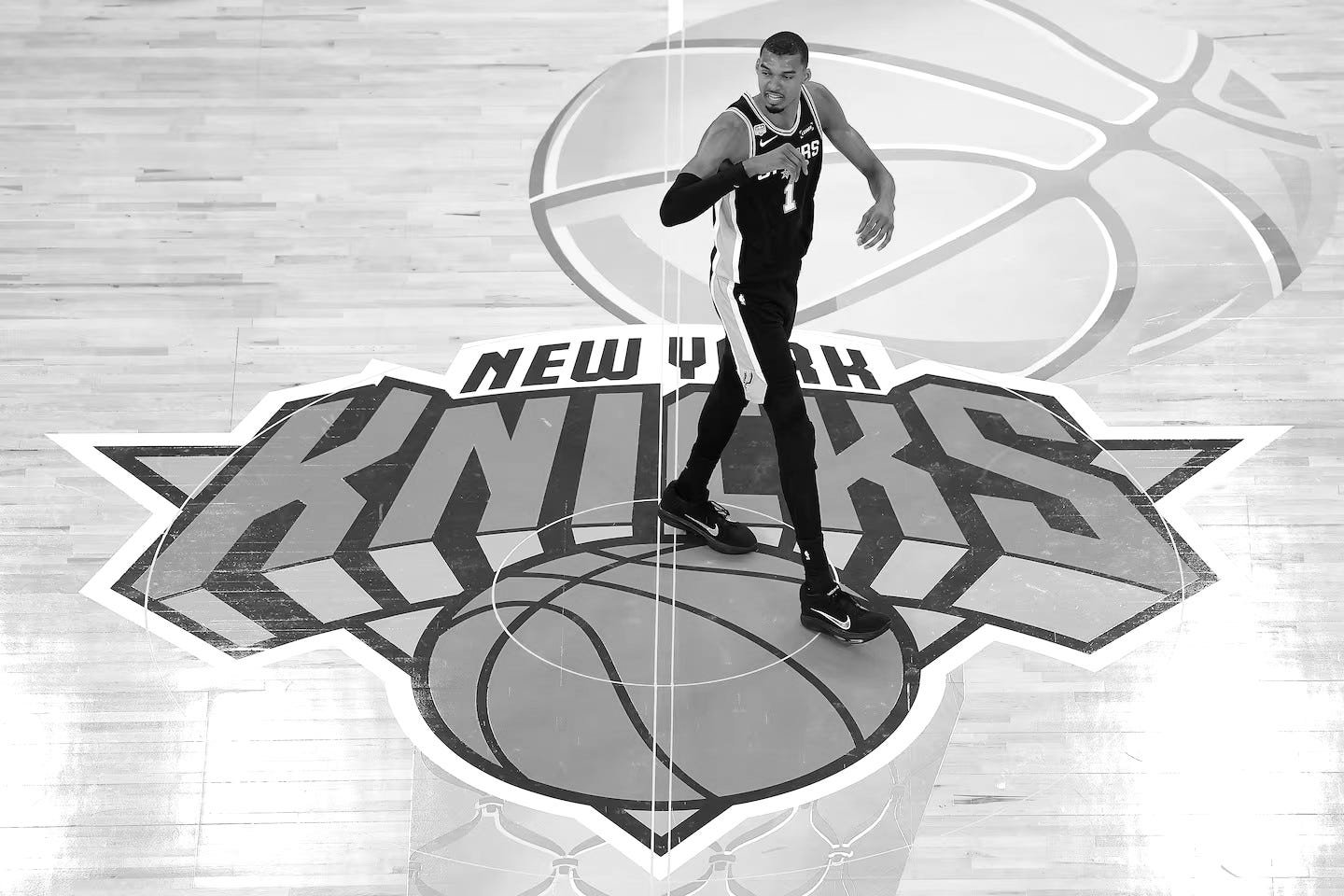
the knicks held the test conditions constant. same scheme, same physicality, same crowd, louder. wembanyama changed inside them. that is the result that should keep new york’s staff awake, because a player who improves between games of a series is a player whose ceiling the series cannot locate. each game has been a cleaner read than the last. the machine keeps running and the curve keeps bending toward the rim.
which leaves mike brown, the only person in the building who misread his own results. brown spent most of a 12-minute postgame press conference on the free-throw disparity. “maybe we were fouling. but they fouled, too,” he said. fair, as far as it goes. a team that attempts eight second-half free throws was either historically clean or historically unlucky, and brown chose his interpretation.
his players ran the same numbers and reached a different conclusion. “that ain’t cost us the game,” towns said. “they kicked our ass tonight,” landry shamet said. the locker room pointed at the 13 turnovers, the 7-of-27 fourth quarter, the offense brown himself called the most stagnant he had seen all year. the symptoms were internal. the coach blamed the thermometer.
this matters beyond one press conference. what a coach says after a loss is a reading of what he has not yet seen, and brown, after 46 days without needing to diagnose anything, reached first for the whistles. the knicks are still up 2-1, still at home wednesday, still the deeper team with the steadier rotation. but the team that wins game 4 will be the one whose self-diagnosis was honest. san antonio already showed its work.
monday measured everyone. wednesday measures what they learned.