

small machine with one job
utah needs darryn peterson to be there, and to hand the ball to someone else, and his talent decides neither.
the loudest thing darryn peterson did in his first fortnight as a professional was set an alarm.
it lives on his phone. it goes off at the same hour every day and it tells him to feed his dog. the dog is named denim. this was, by a wide margin, the most widely reported detail of the second overall pick’s summer. it filed alongside the news that he does not go out much, and that keyonte george has taken to describing him as the guy who walks a dog around downtown. peterson has been open about his ambitions in this area.
“i want to be dad of the year,” peterson said.
an alarm is a small machine with one job. it exists because something fails without it. a nineteen-year-old aimed it at the single obligation he could not stand to miss, and set it to repeat forever.
utah is going to spend the next four years asking him for the same thing at scale.
the basketball was never the question. peterson opened the salt lake city summer league on july 4 with 28 points in 27 minutes on 11-of-21 shooting, and the jazz beat atlanta by one in overtime. two days later he took apart a memphis team that had started four nba players and finished with 12 assists. across those two nights he averaged 26.5 points on 52.8% from the field and 43.8% from three, with 7.0 assists. a rival scout with decades in the league watched and said it all looked easy for him.
vegas was rougher and more useful. against aj dybantsa and washington on july 9 he scored 24 on 6-of-18, missed five of his seven from distance, gave the ball away eight times and was whistled nine. utah lost 92-88. four days later keaton wagler, the fifth pick, dropped 18 points in a single third quarter and outplayed him across the night. by the end peterson had roughly as many assists as turnovers, depending on which outlet counted the games.
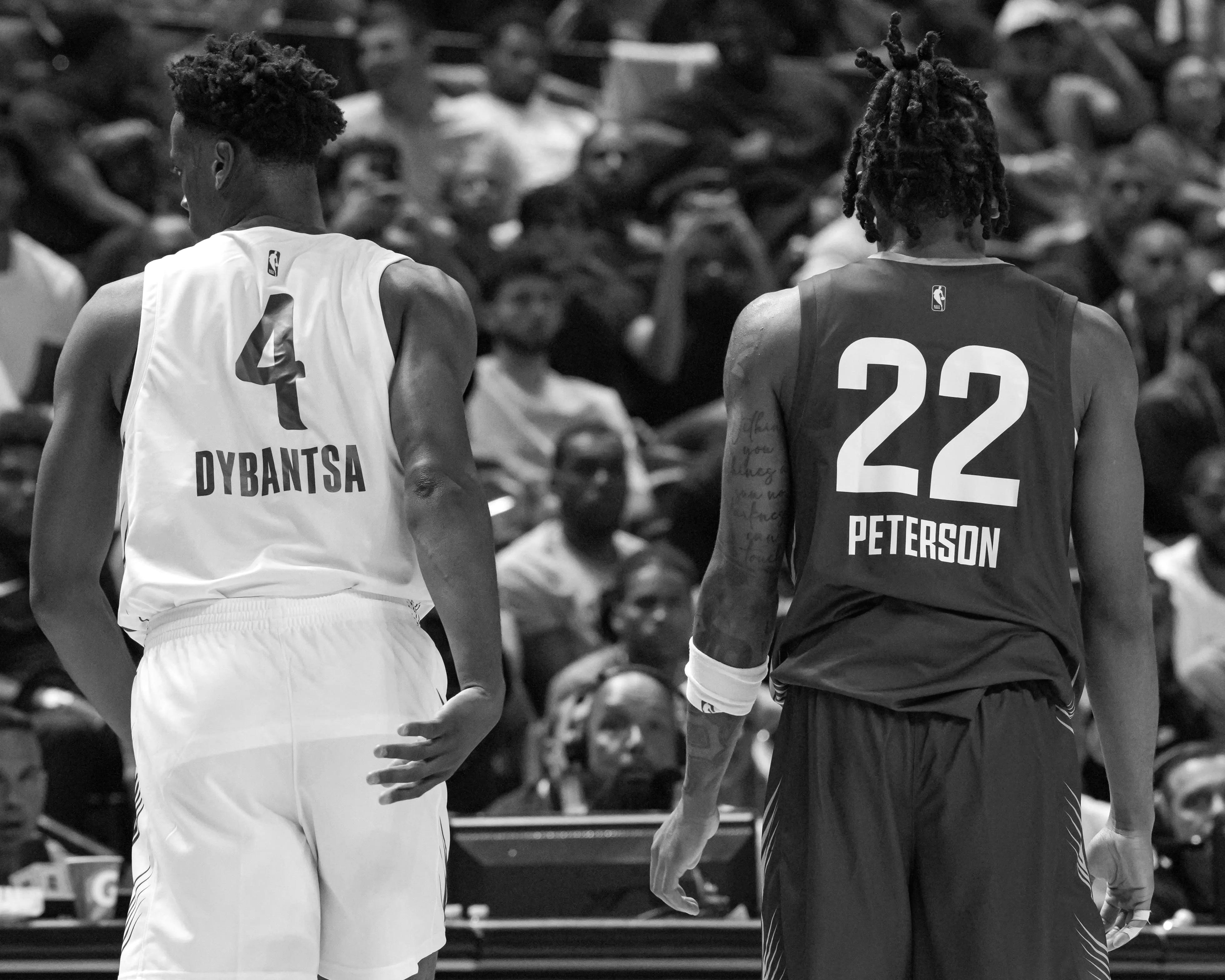
none of that is the file.
the file is kansas. twenty-four games. a hamstring took six of them. cramping in his quads took whole second halves, over and over, until his absence from second halves became a national story. he sprained an ankle against colorado in january. he got the flu in february and missed arizona. he averaged 20.2 points anyway and made second-team all-big 12 anyway. by march, the question the league was asking about the most gifted perimeter scorer in his draft class had stopped being about his jumper.
“can he consistently deal with the grind of an 82-game season?” is the question.
the surface of this summer is a scoring average. underneath it is a league that has spent three years quietly writing attendance into statute, and a franchise that just spent the second pick of the deepest draft in years on the test case.
keyonte george is already living inside the rule.
george averaged 23.6 points and 6.1 assists last season. he was one of eighteen players in the league to raise his scoring average by 6.8 points or more, and one of eleven to clear 23 points and six assists. he was not a candidate for most improved player. the league passed a rule that says an award requires 65 games, george did not have 65 games, and the ballot never saw him.
the 65-game rule was sold as a fix for load management. what it built was a set of trophies that double as attendance records. george played well enough. he was not there often enough. the award measures both things and counts one of them, and the season he had is now a season that happened without official notice.
this is the backcourt utah has bet the franchise on. two guards. the same personal trainer, phil beckner, which is how they knew each other before the draft. the same open question.
