

everything orlando had ran through one calf
franz wagner missed 48 regular-season games and three playoff games, and the magic never survived either absence.
the injury happened in the third quarter of game 4. franz wagner drove baseline, absorbed contact, and landed wrong. he walked to the bench under his own power, which is the kind of detail that makes you think it might be fine. it was not fine. he did not play again in the series. the magic, who had led 3-1, lost three straight games and were eliminated at home by 22 points in game 7.
one calf. three games. sixteen years without a playoff series win extended to nineteen.
the obvious story is the collapse. the 19 points in the second half of game 6, a playoff record, 23 consecutive missed shots, a 24-point lead turned into a 14-point loss on home floor. that story is real. but it is the wrong unit of analysis. the collapse did not happen because the magic forgot how to play basketball. it happened because the one player who made their system coherent was sitting on the bench in a walking boot, watching desmond bane air-ball a pull-up three with five minutes left in the fourth quarter.
this is what the magic built. a roster where one calf muscle was the difference between contender and historical footnote.
wagner finished the regular season at 34 games played. not because of one injury. because of a high-ankle sprain in december, an aggravation in february, and then the calf in april. in the four games he played against the pistons, orlando outscored detroit by 14.7 points per 100 possessions. in the three games without him, they scored 19 points in a half, 8 points in a fourth quarter, and 49 points across six consecutive quarters. the math is not subtle.
the preferred starting five of jalen suggs, bane, wagner, paolo banchero and wendell carter jr. played 182 minutes together during the regular season. 182 minutes in 82 games. the front office spent four first-round picks and a pick swap acquiring bane to make that lineup functional. they never had enough regular-season minutes to build the habits that survive playoff pressure. and then wagner got hurt, and the question became academic.
wagner is the only player on this roster who does two things at the same time: create offense and defend the opponent’s best perimeter scorer. banchero is orlando’s best offensive player. bane is their best shooter. suggs is their best or second-best defender. but wagner is the one who holds the system together at both ends. he was defending cade cunningham as primary defender in games 1 through 4. cunningham shot 42.4% overall, 28.6% from three, and committed 6.8 turnovers per game in those four games. in games 5, 6, and 7, with wagner absent, cunningham averaged 32 points and was the best player on the floor by a distance.
the magic knew this. the coaching staff knew this. and they built a roster where knowing it was not enough.
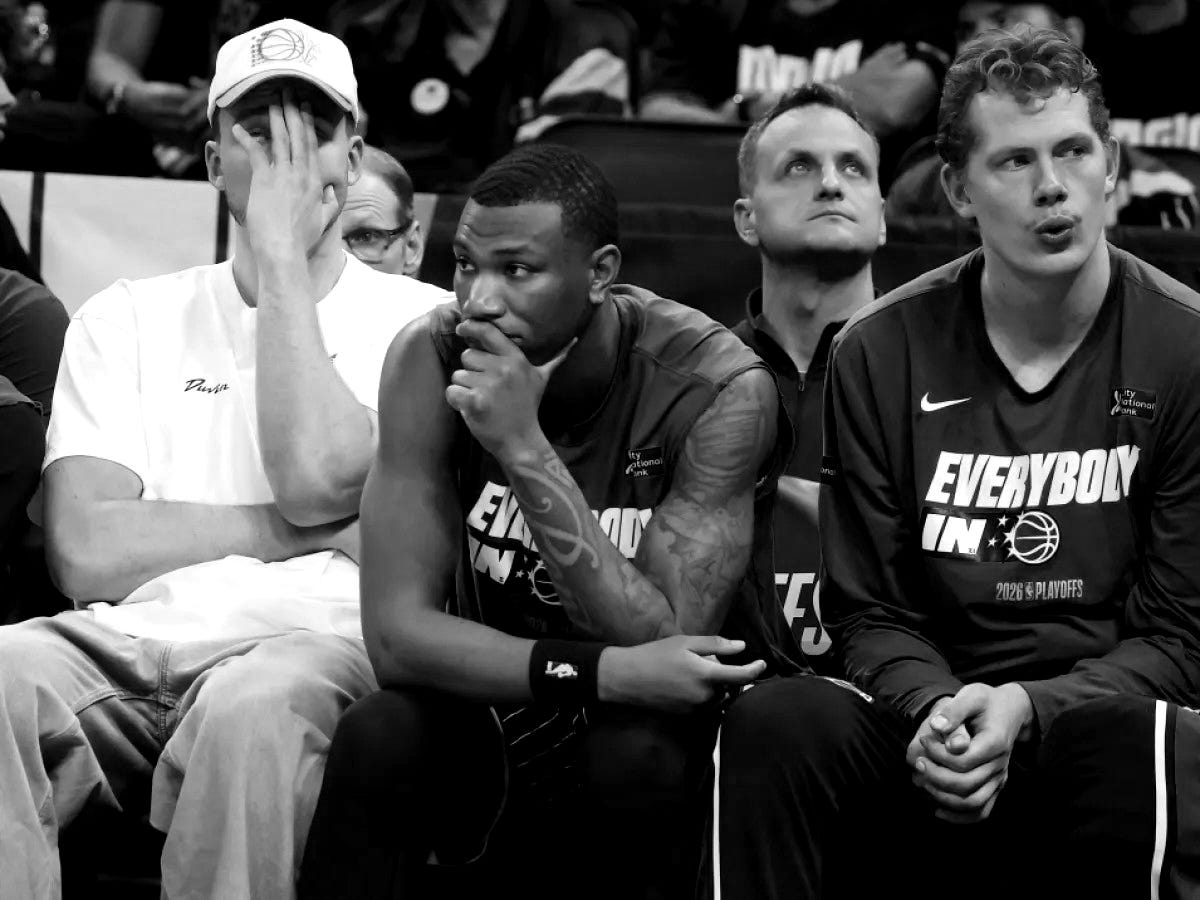
the banchero-wagner pairing has an existential problem that four years of injury-interrupted development has never resolved. both players are 6-foot-10 wing-forwards who operate as de facto point guards. both need the ball. both are below-average three-point shooters by position. when one of them is absent, the other is left with teammates who can defend but cannot reliably create or convert. jalen suggs shot 24.1% from three in the series. carter had two blocks and zero rebounds in game 6. bane, acquired specifically to provide the shooting this roster lacked, missed 23 shots in the second half of two games.
the magic ranked 11th in wide-open three-point attempts this season. they ranked 28th in accuracy, converting 36.5% of those shots. 28th. they generated the looks. they could not make them. and that is not a coaching problem. that is a personnel problem that mosley inherited, extended, and was then fired for not solving.
“i want to say yes,” banchero said after game 7, when asked if the magic are good enough to win. “but this is the third straight time we haven’t gotten out of the first round. so if you are going off the last three years, the answer is no.”
he was sitting on a postgame news conference stage and he could not manufacture the diplomatic answer. three years of first-round exits. a 3-1 lead against the top seed, and then a record that will live in playoff history for the wrong reasons. the magic scored 19 points in a half. in their home arena. with the series one win from decided.
the record was not the disease. it was the symptom. the disease is a roster built around two ball-dominant forwards who cannot space the floor, with a point guard who shot 24% from three in the series, a backup point guard situation so compromised they traded tyus jones before the deadline and attached two second-round picks to do it, and a single player capable of holding the system together on both ends. that player strained his calf in the third quarter of game 4.
this offseason, the magic will hire a new coach, probably someone whose name has been circulating since october. they will talk about offensive scheme, about unlocking the banchero-wagner pairing, about getting healthy and seeing what this roster can do when whole. they will not be wrong. those conversations are necessary.
but the deeper question is structural. banchero and wagner are maximum-salary players. suggs earns $32.4 million next season. bane earns $39.4 million. the magic are already projected over the first apron as currently constructed. they have fewer first-round picks than they did a year ago. the margin for error in adding a perimeter shooter or a true point guard is measured in midlevel exceptions and second-round picks, not transformative trades.
“had we stayed healthy,” jeff weltman said, “i’d like to imagine where we would have gone in this series and beyond.”
he is not wrong. the five-man lineup with wagner was genuinely elite. 105.2 points per 100 possessions allowed in their 182 minutes together. the offensive rating was impressive. the problem is that 182 minutes is not a team. it is a sample. and a sample cannot tell you what happens when the floor collapses in game 6.
what happened in game 6 was not a mystery. the pistons elevated their defensive pressure at the point of attack, and the magic had no one left who could navigate it. banchero is excellent. he scored 38 points in game 7 and his team still lost by 22. the team needed wagner to tell banchero where to go. it needed wagner to make cunningham work for every bucket. it needed wagner to be the player who absorbs the second adjustment, the one every opponent makes at halftime when they realize what is working.
wagner was in a walking boot.
“when one of your best players goes down, it definitely changes a lot,” wendell carter jr. said. “we still gave ourself a chance even with him being out. i think we just drank the kool-aid.”
they drank the kool-aid of the 3-1 lead, of the 24-point third-quarter advantage, of the belief that what they had built was enough. it was enough when wagner was on the floor. it was a playoff record when he was not.
the magic have not won a playoff series since 2010. sixteen years. three rebuilds. one banchero, one wagner, one bane trade that cost four first-round picks. and one calf that decided all of it.
that is not bad luck. that is architecture without redundancy. the magic have had one player capable of holding both ends of the system together at the same time. in the third quarter of game 4, he strained his calf, and three games later the season was over.
the series ended when wagner walked to the bench. everything after was paperwork.