

demand
how the worst 24 hours in warriors front office history turned leverage into catastrophe.
start of the second quarter, chase center, warriors down 20 to toronto. steve kerr calls jonathan kuminga’s number for the first time since december 18. crowd gives him polite applause. kuminga checks in, catches in the post, spins baseline, finishes. 21 minutes later he’s got 20 points on 7-of-10 shooting and the warriors lost by 18 anyway.
here’s what mike dunleavy said before the game, asked about kuminga’s trade demand: “when you make a demand, there needs to be demand on the market.”
that’s the kind of line gms think in private and say never. it’s telling a player his leverage doesn’t exist because nobody’s calling. it’s weaponizing market forces as public humiliation. it’s also, as of tuesday night, the quote that defines how catastrophically wrong every warriors decision of the past week looks in the aftermath of jimmy butler’s torn right acl.
24 hours. that’s how long it took for dunleavy’s line to go from savage dismissal to organizational self-immolation. monday night, butler went down. tuesday afternoon, dunleavy delivered the quote. tuesday night, kuminga scored 20 and the warriors got crushed anyway while surrendering 145 points to a raptors team that did whatever it wanted.
aaron turner, kuminga’s agent, responded publicly after the game. didn’t issue statement. just posted kuminga’s stat line with pointed commentary. that’s how you know the relationship is past saving. agents don’t subtweet gms unless the bridge is already ash and everyone’s just arguing about who lit the match.
so here’s where the warriors are: they publicly tanked kuminga’s trade value right before desperately needing him. they froze him out for 16 games then begged him to save them. they told the league he has no market then watched that market shrink further because everyone now knows golden state is negotiating from a position of maximum desperation.
and the deadline is 14 days away.
start with what dunleavy actually said, because context makes it worse. he was asked about kuminga’s trade demand. kuminga requested a trade january 15, first day he became eligible. sat out 16 straight games. warriors made it clear through every possible signal that kuminga wasn’t part of the future. then butler tore his acl and suddenly kuminga is the only athletic wing on the roster.
dunleavy could have said anything. “we’re exploring options.” “conversations are ongoing.” “jonathan’s a talented player and we’ll see what’s available.” standard gm speak that keeps doors open.
instead: “when you make a demand, there needs to be demand on the market.”
that’s not gm work. that’s a gm telling the league that golden state is stuck with a player nobody wants, which craters whatever trade value still existed. sacramento was interested. they lowered their offer recently, refusing to include even a protected first-round pick. dallas kicked tires. that was the market before dunleavy’s quote. now imagine being sacramento’s front office. why offer anything substantial when golden state’s gm just admitted on the record that he’s got no leverage?
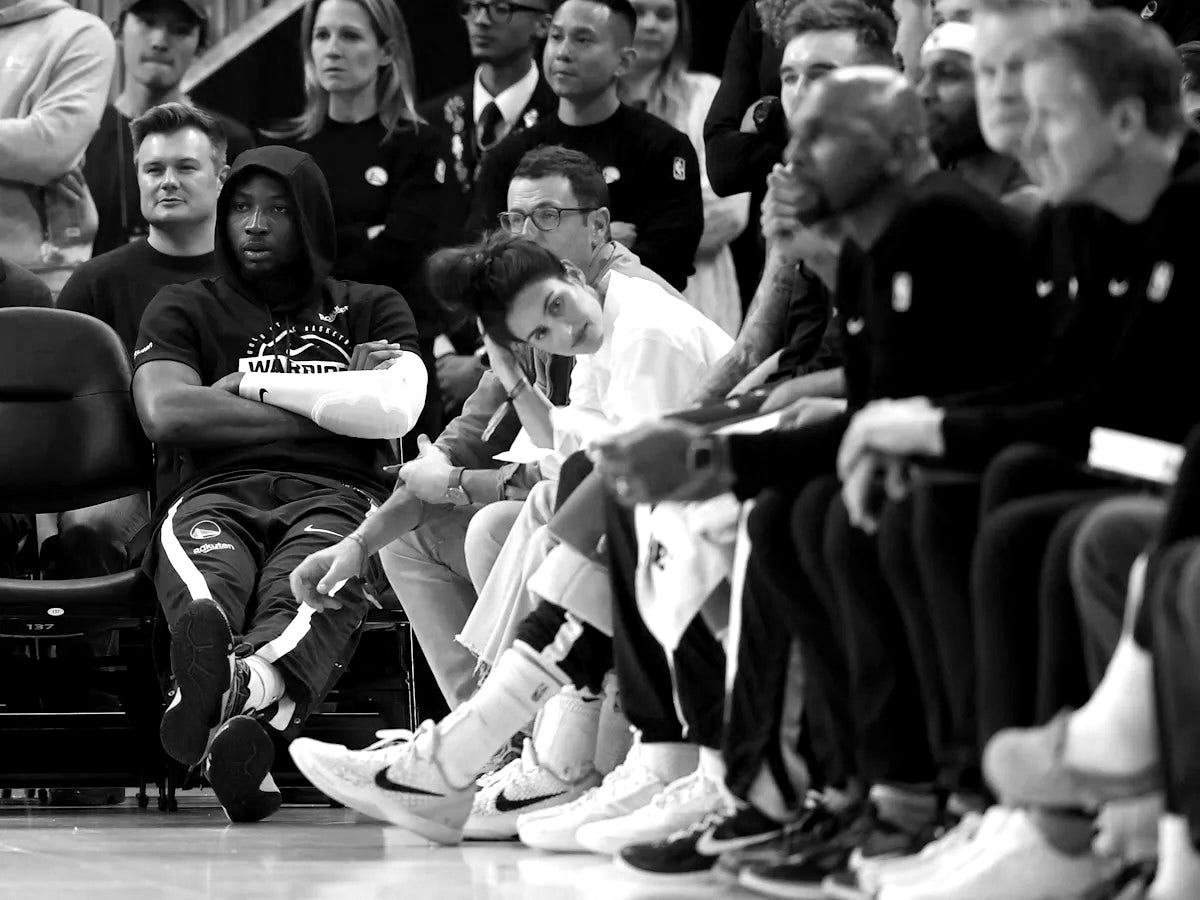
kuminga has two weeks to prove demand exists, but his own gm already told the world it doesn’t. playing well tuesday raises his value fractionally, but not enough to undo months of organizational dysfunction broadcast in real time. and if kuminga keeps playing well, the warriors face a worse problem: do they trade a 23-year-old athletic wing who just averaged 24.3 points on 55.4% shooting in last year’s playoffs for a return everyone knows is depressed?
there’s no good answer. dunleavy made sure of that.
the economic reality underneath this makes everything heavier. the warriors gave butler a two-year, $112 million extension when they traded for him last february. that extension was the cost of acquiring butler. it was also a declaration: we’re going for it while steph curry is still steph curry.
they got 11 months. butler is owed $54.1 million this season. he’s owed $56.8 million next season, when he’ll be 37 years old and recovering from acl reconstruction. the average return-to-play timeline is 11 months. that puts butler back around christmas 2026, meaning the warriors will pay $56.8 million next season for maybe half a season of a 37-year-old coming off major knee surgery.
curry turns 38 in march. draymond green has a $27.7 million player option for 2026-27. the warriors are $22.7 million over the second apron this season. they have no exceptions. they already traded future picks to get butler.
dunleavy said tuesday he doesn’t envision trading butler’s contract, even attached to draft picks. that means golden state is eating $56.8 million in dead money next season regardless of what happens with kuminga. they’re paying for a player who won’t play while their championship window calcifies in real time.
this is what doing right by steph looks like when injury timing doesn’t cooperate. the warriors mortgaged flexibility for 11 months of butler. they bet curry still had two years of elite play left and butler could be the co-star. the bet failed. now they’re holding the bill and the only asset they have to recoup anything is the young player they just spent two months telling everyone isn’t good enough.
the kuminga situation was always going to be messy. relationship between player and coach is, per shams charania, “fractured beyond repair.” kuminga believes he’s been misused and disrespected. warriors believe kuminga doesn’t fit their system and won’t accept his role. those aren’t negotiable differences. those are structural incompatibilities.
but the warriors had options before monday night. they could have traded kuminga for whatever sacramento offered. could have attached him to a larger deal. could have moved him for future assets. the market wasn’t great but it existed.
then butler went down and dunleavy said the quiet part out loud and suddenly every path narrowed. if they trade kuminga now for depressed return, they’re admitting they mismanaged the situation so badly they had to give away a young asset for nothing. if they keep kuminga and try to repair the relationship, they’re contradicting everything they’ve said for two months about it being beyond repair. if they do nothing and hold him past the deadline, they’re stuck with this exact problem all summer while paying $56.8 million for butler to rehab.
the deadline is february 5. that’s 14 days. the warriors have two weeks to decide which loss they can live with, because all three options are losses.
kuminga playing well doesn’t simplify the decision. it makes it harder. if he strings together five or six strong games before february 5, does that prove he’s part of the solution or just that he can produce when given minutes, which everyone already knew? does it prove the relationship is salvageable or just that kuminga is professional enough to play basketball even when he wants out?
there’s no way to know. sample size is too small. information is too unclear. relationship is too damaged. and the deadline forces a decision anyway.
underneath everything sits the curry clock, which is the only timeline that actually matters. curry is 37. he’s averaging 31 points on 47% shooting. he’s healthy. he’s the oldest all-star starter by six years. every decision the warriors have made for two years has been about maximizing curry’s remaining elite window.
they traded for butler. they gave butler $112 million. they froze kuminga out to make room for butler. they let the kuminga situation deteriorate because butler was supposed to be the co-star who made it all work.
butler lasted 38 games this season. the warriors are 25-19, eighth in the west, three games ahead of the play-in cutoff. they’ve won 12 of their last 16, which created belief that this group could still be dangerous in may. that belief died monday night when butler went down.
now the warriors have $56.8 million committed to a player who won’t play next season, a young wing who wants out, a gm who publicly destroyed that wing’s trade value, and 14 days to figure out which mistake they can afford to compound.
dunleavy will make a decision. kuminga will get traded or he won’t. the warriors will retool or they’ll ride what they have into the sunset. curry will age another year. butler will rehab. the deadline will pass.
but the structural problem doesn’t change. the warriors bet everything on extending curry’s window and the injury gods didn’t cooperate. you can’t game-plan for acl tears. you can’t predict when a 36-year-old’s knee gives out on a routine play. all you can do is make the best decisions possible with the information available and hope the breaks go your way.
the breaks didn’t go their way. and now we get to see what a front office does when every decision of the past 24 hours looks catastrophically worse in hindsight and the deadline is two weeks out and the star is aging and the money is committed and the relationship with the only young asset is fractured beyond repair.
dunleavy said when you make a demand there needs to be demand on the market. he was talking about kuminga. he could have been talking about golden state’s entire situation. you can demand one more title run all you want. the market doesn’t care what you demand if nobody’s buying what you’re selling.
kuminga scored 20 points and the warriors still lost by 18 and the quote is still true and the deadline is still coming.